He spent most of his childhood in
France, and, while there, had an experience he claimed affected his perception of the world more significantly than any other. As Deborah B. Gaensbauer describes in Eugene Ionesco Revisited, "Walking in summer sunshine in a white-washed provincial village under an intense blue sky, [Ionesco] was profoundly altered by the light."
[3] He was struck very suddenly with a feeling of intense luminosity, the feeling of floating off the ground and an overwhelming feeling of well-being. When he "floated" back to the ground and the "light" left him, he saw that the real world in comparison was full of decay, corruption and meaningless repetitive action. This also coincided with the revelation that death takes everyone in the end.
[4]Much of his later work, reflecting this new perception, demonstrates a disgust for the tangible world, a distrust of communication, and the subtle sense that a better world lies just beyond our reach. Echoes of this experience can also be seen in references and themes in many of his important works: characters pining for an unattainable "city of lights" (The Killer, The Chairs) or perceiving a world beyond (A Stroll in the Air); characters granted the ability to fly (A Stroll in the Air, Amédée); the banality of the world which often leads to depression (the
Bérenger character); ecstatic revelations of beauty within a pessimistic framework (Amédée, The Chairs, the Bérenger character); and the inevitability of death (Exit the King).
He returned to Romania with his father in 1925 after his parents divorced. There he attended
Saint Sava National College, after which he studied
French Literature at the
University of Bucharest from 1928 to 1933 and qualified as a teacher of
French. While there he met
Emil Cioran and
Mircea Eliade, and the three became lifelong friends.
In 1936 Ionesco married Rodica Burileanu. Together they had one daughter for whom he wrote a number of unconventional children's stories. He and his family returned to France in 1938 for him to complete his Doctoral Thesis. Caught by the outbreak of
World War II in 1939, he remained there, living in
Marseille during the war before moving with his family to Paris after its liberation in 1944.
Ionesco was made a member of the
Académie française in 1970
[2]. He also received numerous awards including Tours Festival Prize for film, 1959; Prix Italia, 1963; Society of Authors Theatre Prize, 1966; Grand Prix National for theatre, 1969; Monaco Grand Prix, 1969;
Austrian State Prize for European Literature, 1970;
Jerusalem Prize, 1973; and honorary Doctoral Degrees from
New York University and the Universities of
Leuven,
Warwick and
Tel Aviv. Eugène Ionesco died at age 84 on
March 29,
1994 and is buried in the
Cimetière du Montparnasse in
Paris. Although Ionesco wrote almost entirely in French, he is one of Romania's most honored artists.
Though best known as a playwright, plays were not his first chosen medium. He started writing poetry and criticism, publishing in several Romanian journals. Two early writings of note are Nu, a book criticizing many other writers including prominent Romanian poets, and Hugoliade, or, The grotesque and tragic life of Victor Hugo a satirical biography mocking
Victor Hugo's status as a great figure in French literature. The Hugoliade includes exaggerated retellings of the most scandalous episodes in Hugo's life and contains prototypes for many of Ionesco's later themes: the ridiculous authoritarian character, the false worship of language.

Like
Samuel Beckett, Ionesco came to the theatre late: he did not write his first play until 1948 (
La Cantatrice chauve, first performed in 1950 with the English title The Bald Soprano). At the age of 40 he decided to learn English using the
Assimil method, conscientiously copying whole sentences in order to memorize them. Re-reading them, he began to feel that he was not learning English, rather he was discovering some astonishing truths such as the fact that there are seven days in a week, that the ceiling is up and the floor is down; things which he already knew, but which suddenly struck him as being as stupefying as they were indisputably true[
citation needed].
This feeling only intensified with the introduction in later lessons of the characters known as "Mr. and Mrs. Smith". To his astonishment, Mrs. Smith informed her husband that they had several children, that they lived in the vicinity of London, that their name was Smith, that Mr. Smith was a clerk, that they had a servant, Mary, who was English like themselves. What was remarkable about Mrs. Smith, he thought, was her eminently methodical procedure in her quest for truth. For Ionesco, the clichés and truisms of the conversation primer disintegrated into wild caricature and parody with language itself disintegrating into disjointed fragments of words. Ionesco set about translating this experience into a play, La Cantatrice Chauve, which was performed for the first time in 1950 under the direction of
Nicolas Bataille. It was far from a success and went unnoticed until a few established writers and critics, among them
Jean Anouilh and
Raymond Queneau, championed the play.
Ionesco's earliest works, and his most innovative, were one-act nonsense plays:
La Cantatrice chauve (1950),
La Leçon translated as The Lesson (1951),
Les Chaises translated as The Chairs (1952), and
Jacques ou la soumission translated as
Jack, or The Submission (1955). These absurdist sketches, to which he gave such descriptions as "anti-play" (anti-pièce in French) express modern feelings of alienation and the impossibility and futility of communication with
surreal comic force, parodying the conformism of the bourgeoisie and conventional theatrical forms. In them Ionesco rejects a conventional story-line as their basis, instead taking their dramatic structure from accelerating rhythms and/or cyclical repetitions. He disregards psychology and coherent dialogue, thereby depicting a dehumanized world with mechanical, puppet-like characters who speak in
non-sequiturs. Language becomes rarefied, with words and material objects gaining a life of their own, increasingly overwhelming the characters and creating a sense of menace.
With
Tueur sans gages translated as The Killer (1959; his second full-length play, the first being Amédée, ou Comment s'en débarrasser in 1954), Ionesco began to explore more sustained dramatic situations featuring more humanized characters. Notably this includes Bérenger, a central character in a number of Ionesco's plays, the last of which is
Le Piéton de l'air translated as A Stroll in the Air.
Bérenger is a semi-autobiographical figure expressing Ionesco's wonderment and anguish at the strangeness of reality. He is comically naïve, engaging the audience's sympathy. In The Killer he encounters death in the figure of a serial killer. In
Rhinocéros he watches his friends turning into rhinoceri one by one until he alone stands unchanged against this tide of conformism. It is in this play that Ionesco most forcefully expresses his horror of ideological conformism, inspired by the rise of the
fascist Iron Guard in
Romania in the 1930s. Le Roi se meurt translated as Exit the King (1962) shows him as King Bérenger 1st, an
everyman figure who struggles to come to terms with his own death.
Like
Shaw and
Brecht, Ionesco also contributed to the theatre with his theoretical writings (Wellwarth, 33). Ionesco wrote mainly in attempts to correct critics who he felt misunderstood his work and therefore wrongly influenced his audience. In doing so, Ionesco articulated ways in which he thought contemporary theatre should be reformed (Wellwarth, 33). Notes and Counter Notes is a collection of Ionesco's writings, including musings on why he chose to write for the theatre and direct responses to his contemporary critics.
In the first section, titled "Experience of the Theatre", Ionesco claimed to have hated going to the theatre as a child because it gave him "no pleasure or feeling of participation" (Ionesco, 15). He wrote that the problem with realistic theatre is that it is less interesting than theatre that invokes an "imaginative truth", which he found to be much more interesting and freeing than the "narrow" truth presented by strict realism (Ionesco, 15). He claimed that "drama that relies on simple effects is not necessarily drama simplified" (Ionesco, 28). Notes and Counter Notes also reprints a heated war of words between Ionesco and
Kenneth Tynan based on Ionesco's above stated beliefs and Ionesco's hatred for Brecht and Brechtian theatre.
Ionesco is often considered a writer of the
Theatre of the Absurd. This is a label originally given to him by
Martin Esslin in his book of the same name, placing Ionesco alongside such contemporary writers as
Samuel Beckett,
Jean Genet, and
Arthur Adamov. Esslin called them "absurd" based on
Albert Camus' concept of the absurd, claiming that Beckett and Ionesco better captured the meaninglessness of existence in their plays than in work by Camus or Sartre. Because of this loose association, Ionesco is often mislabeled an existentialist. Ionesco claimed in Notes and Counter Notes that he was not an existentialist and often criticized existentialist figurehead
Jean-Paul Sartre. Although Ionesco knew Beckett and honored his work, the French group of playwrights was far from an organized movement.
Ionesco claimed instead an affinity for
’Pataphysics and its creator
Alfred Jarry. He was also a great admirer of the
Dadaists and
Surrealists, especially his fellow countryman
Tristan Tzara. Ionesco became friends with the founder of
Surrealism,
André Breton, whom he revered. In Present Past, Past Present, Ionesco wrote, "Breton taught us to destroy the walls of the real that separate us from reality, to participate in being so as to live as if it were the first day of creation, a day that would every day be the first day of new creations."
[5] Raymond Queneau, a former associate of Breton and a champion of Ionesco's work, was a member of the
Collège de ’Pataphysique and a founder of
Oulipo, two groups with which Ionesco was associated.
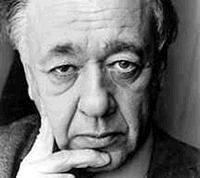
Eugène Ionesco (
1909.
november 26.,
Slatina,
Románia –
1994.
március 29.,
Párizs) román-francia származású francia író, az
abszurd dráma és az
abszurd színház egyik megteremtője. A
Patafizikai Társaság egyik tagja.
1909.
november 26-án látta meg a napvilágot az
Olt megyei Slatina városában,
Romániában. Apja román, míg anyja francia
zsidó volt, így gyermekkorának jelentős részét
Franciaországban tölthette, de a szülei válása után,
1925-ben visszatért apjával Romániába. A
bukaresti egyetemen szerzett
francia nyelvtanári diplomát
1933-ban, diplomamunkáját a
francia irodalomról írta. Az egyetemen ismerkedett meg és lett életreszóló barátja
Emil Cioran és
Mircea Eliade.
1936-ban nősült meg, házasságából egy lánya született.
1938-ban családjával visszatért
Franciaországba, hogy anyagot gyűjthessen a doktori cím megszerzéséhez szükséges munkájához. A
II. világháború ezen gyűjtőmunka közben érte őket, ezért úgy döntöttek, hogy maradnak,
Marseille-ben telepedtek le.
Párizs 1944-es felszabadítása után nem sokkal azonban a tengerpartról a francia fővárosba költöztek.
1948-ban egy
angol nyelvkönyv példamondatainak tanulmányozása közben döbbent rá a kispolgári lét abszurditására. Első abszurd darabját A kopasz énekesnő-t is ebben az évben írta, mely
1950-ben került színpadra, megteremtve ezzel az
abszurd színház világát, ugyanis a darab színpadi rendezése is a könyvből áradó abszurditást tükrözte. (Egész addigi és azt követő életében is ódzkodott a „rendes” színházaktól).
1967-ben látogatást tett
Izraelben, ezután tudomásul vette a fél
zsidó származását firtató pletykákat és híreszteléseket.
1970-ben az
Académie française (Francia Akadémia) rendes tagjává választotta
[1].
1994.
március 29-én, életének 84. évében érte a halál.
Mivel szinte kizárólag francia nyelven írt, joggal tekintik – félig román származása ellenére – francia írónak. Romániában ma az egyik legnagyobb tiszteletnek örvendő szerző.
Még életében díszdoktora lett a
New York-i, a
leuveni, a
warwicki és a
tel avivi egyetemnek, illetve számos díjat is kapott, közülük a legismertebbek:
a Tours Fesztivál filmdíja,
1959Prix Italia,
1963az íróközösség színházdíja,
1966nemzeti nagydíj a színházért,
1969monacói fődíj,
1969osztrák állami kitüntetés az európai irodalomért tett szolgálatai elismeréséül, (
1970)
Jeruzsálem-díj,
1973 
 Ephraim Kishon (Hebrew: אפרים קישון, August 23, 1924 – January 29, 2005) was an Israeli writer, satirist, dramatist, screenwriter, and film director.
 Rosszkor és rossz helyen, az 1920-as években Magyarországon született Hoffmann (később Kishont) Ferenc. Zsidó bankár gyermekeként nem mehetett egyetemre. A zsidótörvények árnyékában ötvösnek tanult, majd Budapest erődítésein dolgozott, ahogyan nyilas őrei mondták: "a bolsevik pestis megfékezésén". Amikor a front elérte a város határát, megszökött, majd két hetet töltött a magyar–német és az orosz frontvonalak között egy pincében, paradicsomlén élve. Ekkor írta Hajvédők című regényét, amelyért díjat is kapott.


.jpg)


